
Buyer's guide
DIY Garage Floor Epoxy Kit vs. a Professional Coating: An Honest Comparison
What separates a big-box garage floor epoxy kit from a professionally installed coating, why DIY floors often peel in Michigan garages, and when a kit is a reasonable choice.
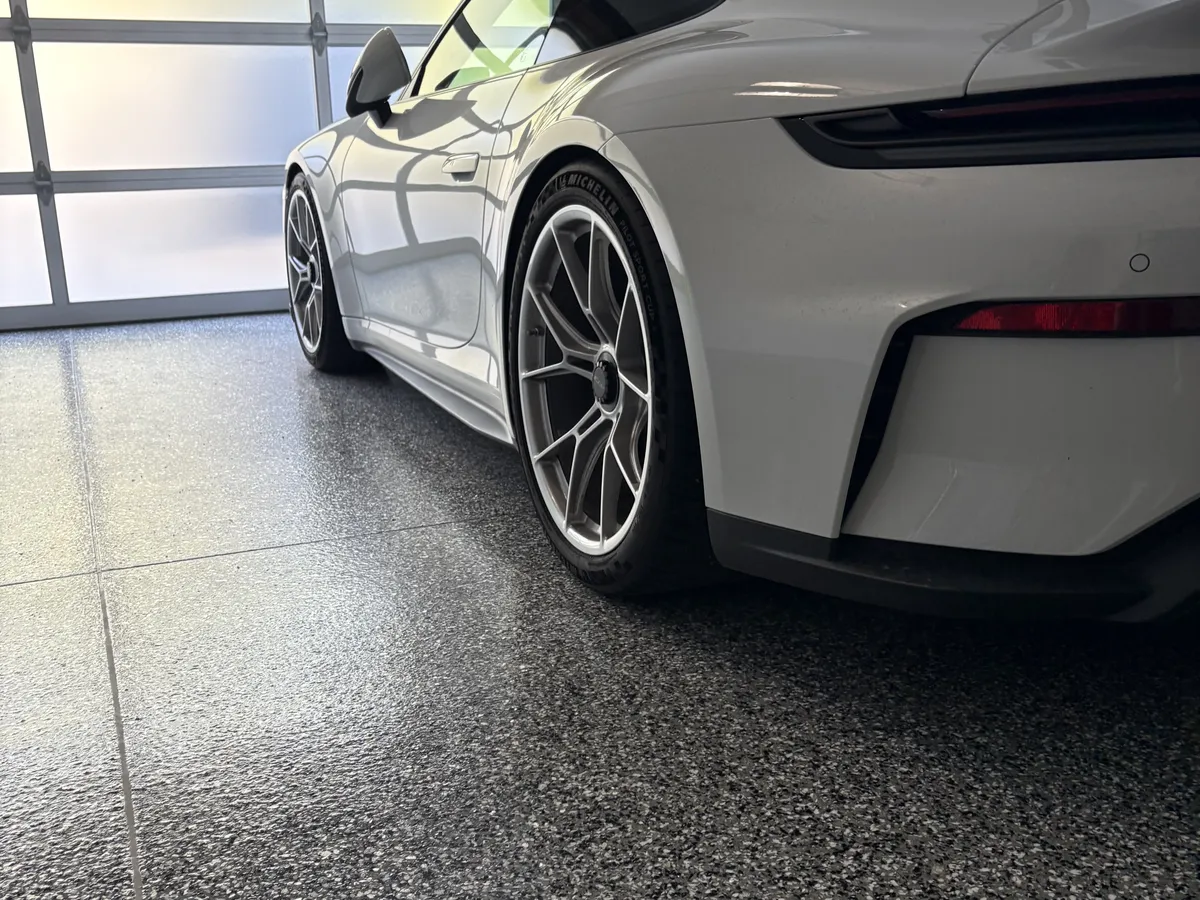
Quick answer
A DIY epoxy kit and a professional garage floor coating can look alike on day one. The difference is underneath: how the concrete is prepared, how thick the system is, and what the topcoat is. Most kits rely on an acid etch and a thin coat. A professional system starts with diamond grinding and crack repair, then builds a thicker, layered floor.
The box looks great. A gleaming grey floor, a sports car, a price that seems almost too good. Garage floor epoxy kits are a hugely popular weekend project, and plenty of Michigan homeowners have spent a Saturday on their knees rolling one out.
Some of those floors still look fine. A lot of them are peeling in tire-shaped patches by the second winter. The difference rarely comes down to how careful the homeowner was. It comes down to what the kit can and cannot do.
Here is an honest comparison from a crew that preps and coats concrete floors for a living.
What is actually in the box
Most retail kits include some version of the following:
- A cleaner or degreaser
- An etching solution (often citric or a mild acid) to "open" the concrete
- A one- or two-part epoxy, often water-based, sometimes with a short pot life
- A bag of decorative flakes
- Sometimes a clear topcoat, sold separately
What is not in the box is the step that decides whether any coating stays down: mechanical surface preparation.
Prep: the part the box makes sound easy
Coatings stick to concrete by gripping into its surface. A smooth, dense or contaminated surface gives them nothing to hold. Industry surface preparation guides, like Sika's concrete surface preparation guide, call for concrete to be mechanically prepared by grinding, shot blasting or similar methods to remove the weak top layer and contaminants and create a profile.
Acid etching is the DIY shortcut. It can work on a clean, porous slab, but it does not remove oil that has soaked in, old sealers, curing compounds or the weak, chalky top layer that a lot of garage floors have. On a Metro Detroit garage that has had years of salty slush and drips from the car, etching often is not enough.
A professional install starts with a diamond grinder and a dust collector. It takes the top layer off, opens the concrete evenly, and removes what etching cannot. Then the damage gets repaired.
Repairs: what kits skip
Michigan garage floors take a beating from road salt and freeze-thaw. Research from Michigan Tech found that some deicing chemicals, like calcium and magnesium chloride, can damage concrete chemically, on top of the physical damage from freezing. In a garage, that shows up as pitting, scaling, spalled edges at the door and cracks.
A kit coats right over those. The coating follows the pits and cracks, and the damaged concrete underneath keeps breaking down. A professional install cuts out and rebuilds spalls and pop-outs, and treats cracks and control joints before anything goes down. If you want to understand the damage on your own floor, read our guide to garage floor spalling and pitting.
Hot tire pickup: the most common DIY failure
If you have seen a DIY floor with bare concrete patches exactly where the tires park, that is hot tire pickup.
After a drive, tires are warm and soft. When the car parks, the tire presses into the coating as it cools, and the rubber can grip the coating. When you back out, the tire pulls the coating up with it. A thin coat over a weakly prepared slab is the most likely to let go. Once one patch lifts, water and salt get under the edges and the peeling spreads.
Hot tire pickup is different from tire staining. Staining is a discoloration from plasticizers in the rubber, as Armorpoxy explains in its tire staining guide. Staining is a cosmetic issue. Pickup is the coating actually coming off the floor.
Thickness and layers
A typical kit goes down as one thin coat, sometimes with flakes sprinkled on top. A professional system is built in layers:
- A base coat that bonds to the ground concrete
- Decorative flake broadcast to refusal, meaning flake is thrown until the base coat cannot take any more
- Loose flake scraped and vacuumed off
- A clear topcoat that locks the flake in and takes the wear
Those layers are what give a coated floor its depth, texture and resistance to wear. You can see each step on our process page.
The topcoat matters in a Michigan garage
Many kits are straight epoxy. Epoxy bonds well and makes a strong base, but most epoxies are not made to hold their color in sunlight, and a garage door left open on a south-facing driveway will show it. Our polyaspartic vs. epoxy guide explains why many professional floors use an epoxy-type base and a polyaspartic topcoat that holds its color and handles Michigan temperature swings.
Timing and conditions
Kit instructions usually list a temperature range and a humidity limit. In a Michigan garage, those conditions can be hard to hit. Cold slabs in spring and fall, humid summer days and damp concrete near Walled Lake and the other lakes all affect how a coating cures. Installers check conditions on the slab itself before starting, not just the air temperature.
The real cost of a kit
The kit price is only part of it. Add:
- Your time, often a full weekend plus waiting days before parking on it
- Rented tools, if you try to grind
- Crack filler, extra flake, a topcoat
- And the cost that surprises people: if a DIY coating fails, it has to be ground off before a new floor can go down. Removing a failed coating is extra work on any future install.
That last point is why a kit is not always the cheaper choice in the long run. Our garage floor coating cost guide explains what actually moves the price of a professional floor in Metro Detroit.
When a DIY kit can make sense
A kit is not always a bad idea. It can be reasonable when:
- The garage is used for storage or a workshop, and cars rarely park inside
- The concrete is newer, clean, sound and has never been sealed or painted
- You are comfortable with the prep, and you accept you may need to touch it up
- You want a short-term cosmetic change while you plan something bigger
It is a poor fit when the slab is pitted, spalled or cracked, when you park daily, especially after highway driving, or when there is an old coating or sealer already on the floor.
Signs your DIY floor is failing
If you already have a kit floor, watch for:
- Bare patches where the tires sit
- Edges lifting at the garage door or along cracks
- White or cloudy areas, which can point to moisture under the coating
- Flakes coming loose or the surface wearing through in traffic lanes
Once a coating starts to lift, patching it rarely holds. The fix is to grind it off and start over on bare concrete.
Side by side
| DIY epoxy kit | Professional coating | |
|---|---|---|
| Surface prep | Clean and acid etch | Diamond grinding with dust collection |
| Crack and spall repair | Usually none | Cut out and rebuilt before coating |
| System | Usually one thin coat | Base coat, full flake broadcast, clear topcoat |
| Topcoat | Often none or epoxy | Clear topcoat chosen for the garage, often polyaspartic |
| Who checks the slab | You | The crew, before quoting |
| If it fails | Grind off and start over | Problems are addressed before install |
Get a straight answer about your floor
If you are on the fence, have someone look at the slab and tell you what it actually needs before you buy anything. Coast to Coast Concrete Coatings works out of our shop at 1525 Leon Rd in Walled Lake and coats garage floors across Oakland, Wayne and Macomb County. If your floor is a good candidate for a simple DIY job, we will say so. Call (248) 624-4400 or request a quote. You can also see finished floors on our garage floors page.
Frequently asked questions
Why do DIY garage floor epoxy kits peel?
Most peel because of prep. Acid etching often does not remove oil, old sealers or the weak top layer of the concrete, and a thin coat over that surface can let go, especially under hot tires. Damage like pitting and cracks underneath also keeps working on the coating.
What is hot tire pickup?
Hot tire pickup happens when warm tires press into a coating as they cool and pull it off the floor when the car backs out. It shows up as bare patches where the tires park and is most common on thin coatings over poorly prepared concrete.
Can a professional coat over my failing DIY epoxy?
Not over it. A failing coating has to be ground off so the new system bonds to bare, sound concrete. That removal is part of the prep we look at when we quote.
Is a DIY kit ever a good idea?
It can be, on newer, clean, sound concrete in a garage used mostly for storage, where you accept touch-ups. On a pitted or cracked slab where you park every day, a professional system is usually the better choice.
How is a professional coating installed?
The slab is diamond-ground, cracks and spalls are repaired, a base coat goes down, flake is broadcast to refusal, the loose flake is scraped off, and the floor is sealed under a clear topcoat.