
Outdoor guide
The Best Coating for a Concrete Patio in Michigan: Sealer, Paint, Stain or Flake?
An honest comparison of the ways to refinish an outdoor concrete patio in Michigan, from clear sealer to a full flake coating, and how to tell which one your slab needs.
Quick answer
For a Michigan patio, the best coating depends on what you want it to do. A clear sealer protects concrete that still looks good. Paint and stain change the color but wear quickly outdoors. A ground, repaired and textured coating system changes the look and closes off the surface. Badly broken concrete should be replaced.
Walk down any street in Novi, Commerce or Farmington Hills in April and you can tell which patios were cared for and which were not. The uncared-for ones are rough and sandy, flaking in patches, with the top layer coming off where the downspout drains. That damage does not come from summer. It comes from winter.
If your patio is starting to look like that, you have more options than you might think, and they are not all equal. Here is how each one holds up on a Michigan patio, in plain terms, so you can pick the right one or at least ask better questions.
Why Michigan patios wear out
Outdoor concrete soaks up water. In Michigan, that water freezes and thaws many times between November and April. Each time it freezes, it expands inside the top of the slab. The U.S. General Services Administration's guide to scaling concrete names freeze-thaw stress and heavy use of deicing salts among the causes of a surface that flakes and peels.
Add the things that happen to patios here:
- Snow piled on the patio all winter, melting slowly in the sun and refreezing at night
- Ice melt tossed down on steps and walkways. Research from Michigan Tech found that some deicers, like calcium and magnesium chloride, can attack concrete chemically as well as physically
- Shade from mature trees keeping part of the slab damp
- Downspouts and roof edges dumping water in the same spot every storm
So the question is not just "what color do I want?" It is "what will keep water from getting into this slab and breaking it down again?"
Option 1: Clear concrete sealer
What it is: A clear liquid, usually acrylic or penetrating silane/siloxane, rolled or sprayed on.
What it does well: Protects concrete that is still in good shape and makes it shed water. Penetrating sealers do not change the look much. Acrylic sealers can add a slight sheen or "wet look."
Where it falls short: It does not change the color, cover stains or hide damage. It wears and needs to be reapplied on a regular basis. A sealer will not fix a patio that is already scaling.
Best for: A newer patio that still looks the way you want it to.
Option 2: Concrete paint or "patio paint"
What it is: A one-part paint from the hardware store, sold for porches and patios.
What it does well: Changes the color for a weekend's work and a low upfront cost.
Where it falls short: Paint sits on top of the concrete instead of bonding into it. Water gets under it from below and around the edges, and freeze-thaw pushes it off. Peeling paint is a common sight on Michigan porches by the second spring. Once it starts, it has to be scraped or ground off before anything better can go down.
Best for: A short-term cosmetic fix where you accept redoing it often.
Option 3: Concrete stain
What it is: An acid-based or water-based stain that colors the concrete itself.
What it does well: Adds color and variation without a thick film on top. Can look rich on smooth, sound concrete.
Where it falls short: Stain does not hide cracks, patches or scaling. It shows them. It also needs a sealer on top to protect it, so you are back to resealing on a schedule. On an older, patched patio, results can be blotchy.
Best for: Sound, fairly new concrete where you want color but not a new texture.
Option 4: Cement-based overlay or resurfacer
What it is: A thin layer of polymer-modified cement troweled or sprayed over the old slab, often with a texture or stamped pattern.
What it does well: Covers a worn surface and can create a stone-like or textured look.
Where it falls short: An overlay is still cement-based, so it is still porous and usually needs sealing. If the slab underneath is moving or cracking, the cracks tend to come back up through the overlay.
Best for: Covering a heavily worn surface when you want a specific decorative pattern.
Option 5: A ground, repaired and coated flake system
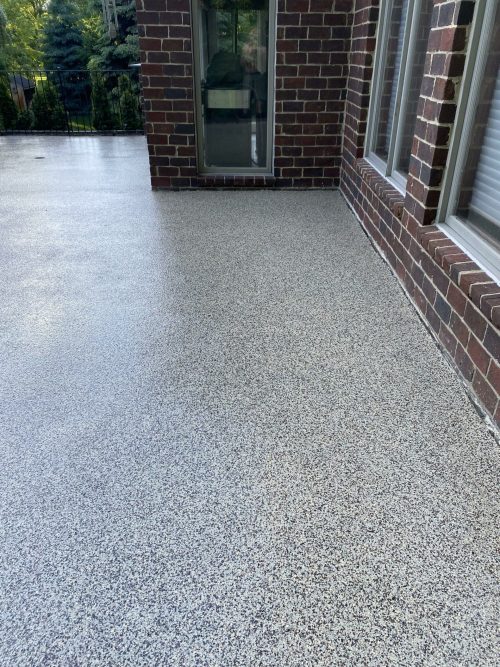
What it is: The same idea as a coated garage floor, adapted for outdoors. The slab is diamond-ground, damage is repaired, a base coat goes down, decorative flake is broadcast into it, and the surface is sealed under a clear topcoat chosen for outdoor exposure. Outdoor work gets a textured finish so it stays grippy when wet.
What it does well:
- Bonds to the concrete instead of sitting on top of it, because the slab is ground first
- Closes off the surface so water has a harder time getting in
- Changes the color and look completely, and the flake hides small imperfections
- Gives grip on steps, walkways and around pools
- Cleans with a hose
Where it falls short: It is more work than paint or sealer, so it costs more upfront. It cannot fix a slab that has settled, heaved or is breaking up deep down. And it needs the right weather to install, so outdoor schedules depend on the season.
Best for: Patios, porches, steps, walkways and pool decks that are worn but structurally sound, where you want a lasting change rather than a yearly touch-up.
You can see real examples on our projects page, including a covered patio, a raised deck slab and a front entry.
Side by side
| Option | Changes the look | Hides wear | Bonds into the slab | Grip when wet | Upkeep |
|---|---|---|---|---|---|
| Clear sealer | Little | No | Penetrating types do | Varies | Reapply regularly |
| Paint | Yes | Some | No | Often slick | Peels, redo often |
| Stain | Color only | No | Yes (colors the concrete) | Same as concrete | Reseal regularly |
| Overlay | Yes | Yes | Bonded layer | Textured | Usually sealed |
| Flake coating system | Yes | Yes | Yes, after grinding | Textured on purpose | Rinse and inspect |
When the answer is "replace it"
A coating, overlay or stain sits on top of the slab you already have. If that slab has problems below the surface, no finish will solve them. Replacement makes more sense when:
- A section has sunk or lifted, creating trip edges
- The patio slopes toward the house and water runs to the foundation
- Large areas are crumbling deep, not just on the surface
- Cracks are wide and getting wider every year
If we look at your patio and see any of this, we will tell you instead of selling you a coating that will not hold.
Questions to ask before you hire anyone
Whoever you call for your patio, these questions will tell you a lot:
- How will you prepare the surface? Grinding or blasting to open the concrete is very different from a pressure wash.
- What happens to the cracks and spalls? Are they repaired before coating, and is that included?
- How do you handle the control joints?
- What texture will it have, and can I feel a sample?
- Is this system made for outdoor exposure? Not every coating is made for sun and freeze-thaw.
- When can you do the work, and what weather do you need?
Patios, pool decks and porches
If your project includes a pool, read our guide to pool deck coating in Michigan, which covers splash-out, saltwater pools and timing around the swim season. For a full look at what we coat outside, visit our outdoor coatings page.
Talk to someone who will look at the slab
Coast to Coast Concrete Coatings is based at 1525 Leon Rd in Walled Lake and works on patios, porches, steps, walkways and pool decks across Metro Detroit. We look at the slab first, tell you which option actually fits it, and bring samples so you can see and feel the finish. Call (248) 624-4400 or request a quote.
Frequently asked questions
What is the most durable coating for an outdoor concrete patio?
On a sound slab, a coating system installed over ground and repaired concrete generally holds up better than paint or a stand-alone sealer, because it bonds to the concrete instead of sitting on top of it. The prep and the condition of the slab matter as much as the product.
Can I just paint my concrete patio?
You can, but paint sits on top of the concrete, and on Michigan patios water and freeze-thaw tend to push it off. Once it peels, it has to be removed before a better finish can go down.
Will a coating fix my cracked patio?
Surface cracks, pits and spalls are repaired as part of prep. A coating will not fix a slab that has settled, heaved or is breaking up deep below the surface. That concrete should be replaced.
Is a coated patio slippery?
Outdoor coatings get a textured finish on purpose so they stay grippy when wet. We bring samples so you can feel the texture before you decide.
When can you coat a patio in Michigan?
Outdoor coating depends on the weather, so it is planned around the season. Call and describe your patio, and we will talk through timing.